|
Research
home page | Next Page |
Previous page
Anodic
Glow Discharge III
Boric
Acid
Anodizing
in boric acid makes a thin nonporous oxide film. Cell impedances
are very high even when using the acid in a concentrated
solution. It was easy to reach 100's of volts at a few milliamps
over a short period of time. The discharge glow color was
greenish yellow, and it became visible at a higher voltage
than the other electrolytes tested.
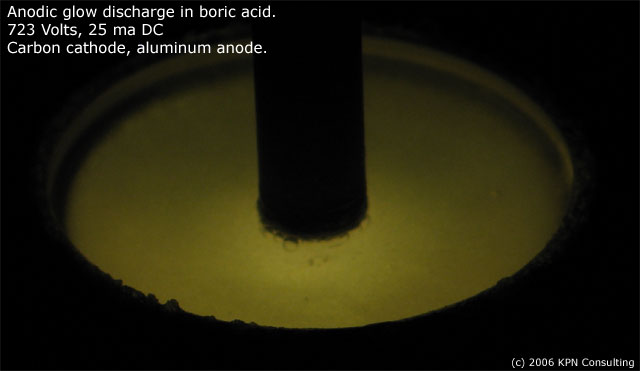
At
high overpotentials a crowding effect took place which concentrated
current at the spot in the center of the anode, as you can
see in the above picture. The whitish/yellow spot directly
beneathe the cathode followed along when I moved the cathode
across the surface of the anode. More about this spot on
the next page.
Oxalic
Acid
In
order to work the higher current regimes required of electrolytes
such as oxalic acid I began using water filled beverage
cans as they provided better heat sinking. I also began
cooling the cans to experiment with colder anode and electrolyte
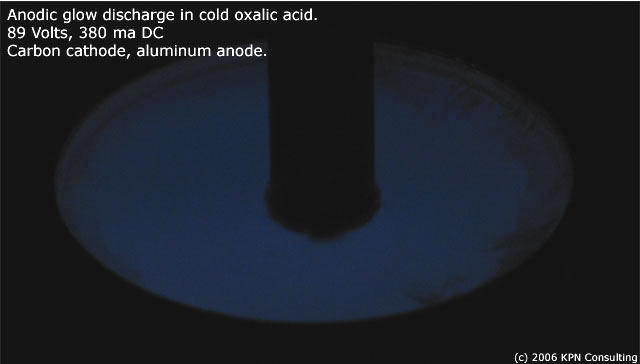
temperatures during conditioning. One of the results of
those experiments was an oxide layer that generated a pale
blue glow under anodic glow discharge.
Next
Page
Research
home page | Next Page |
Previous page
|