|
Research
home page | Previous page
Anodic
Glow Discharge IV
Sodium
Potassium Tartrate
A
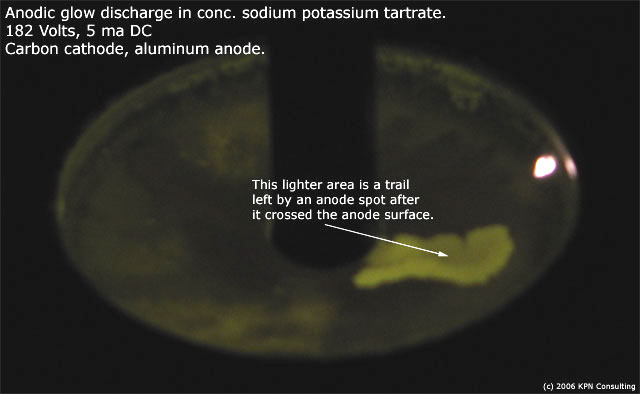
concentrated solution of sodium potassium tartrate conditioned
well up to about 180 volts. This photo shows the dark green
glow after about an hour of conditioning. Note the thick
lighter green patch in the lower right quadrant of the photo.
That's a modification to the oxide surface due to a more
intense discharge regime.
After
about 180 Volts orange sparkling discharges appeared on
the rim and into the center of the anode and were impossible
to control. Trying to condition the cell to higher voltage
just pushed it into continuous arcing. I decided then to
increase the current, and see what would happen after an
actual cathode to anode arc was struck. The results were
unexpected.
An
arc did form directly between the cathode and anode, and
sparging gas bubbles caused the arc to sputter and become
unstable.
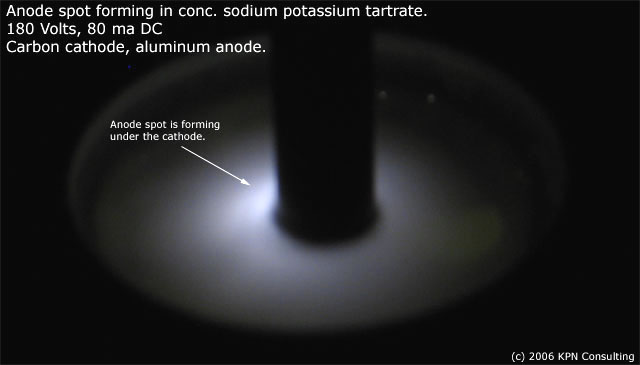
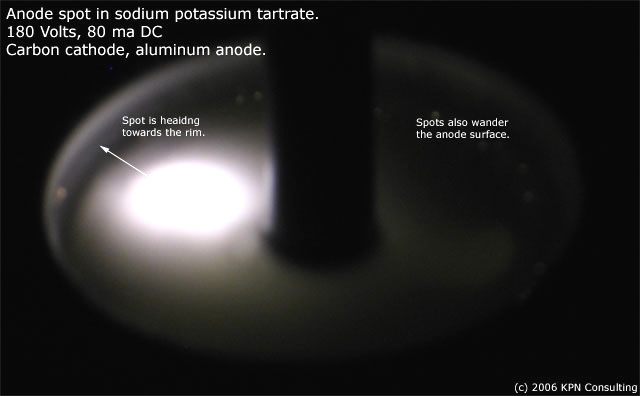
Due
to the volume of gas coming from the cathode, the anode
spot was pushed out from under the cathode and began wandering
the anode surface. First out to the rim, then pausing for
a few moments, then back to the cathode or around the rim.
The spot would also merge with the rim and disappear; a
new spot immediately forming at the cathode and again being
pushed out to wander the anode. The speed of the spot was
slow, in the neighborhood of a cm per second. The spot size
was about the size of the cathode tip.
The
anode spot shedding process ended with a broad glow covering
the anode from cathode to rim, with many colored sparks
and flashing. At this point I shut the cell down and examined
the surface. The oxide layer was modified by the spots passage,
perhaps transformed from boehmite into corundum. I was concerned
that the can might be set afire by this discharge! A safer
arrangement of the experiment would be necessary to further
explore this exotic discharge regime...
Research
home page | Previous page
|