Research
home page | Next Page
| Previous page
Anodic
Glow Discharge II
Can
Preparation
From
the previous photo you could see that surface preparation
greatly affected the resulting oxide layer. I started
to prep the cans in the following manner.
- Scrub
with a plastic scouring pad and soap.
- Wash
with acetone.
- Etch
with a dilute solution of NaOH for 20 minutes.
- Desmut
by wiping or soaking in dilute H2SO4.
- Wash
with distilled water.
The
clean can is now ready to receive an anodizing electrolyte
and be conditioned. While cleaning is not essential to
seeing the effect, it certainly makes the experiments
more predictable and uniform.
Conditioning
Conditioning can occur at
any constant current where the overpotential is continuously
rising. How much depends on a large number of factors.
These experiments were all done in the range of 1 to 500
ma DC, with currents in the 10 milliamp range usually
working for DC conditioning.
It is also possible to 'pulse' condition anodes by exceeding
their conditioning current for a short while. A variety
of different effects can be seen by combining these modes.
What works best strongly depends on the particulars of
the experiment.
Electrolytes
Broadly
speaking, electrolytes can be divided into two categories.
Electrolytes such as citric and boric acid work well in
saturated solutions, and the dominant anode reaction is
the generation of the oxide layer. Oxygen generation at
the anode is minimal. The resulting layer deposits smoothly
over a broad range of current densities, and the cell
impedance is quite high. As a results, high voltages are
required to get enough current density to see substantial
glow.
Electrolytes
such as oxalic acid or sodium pyrophosphate allow for
a great deal of oxygen generation at the anode, consequently
the impedance is low and a porous oxide layer is formed
due to the outgassing. It is very hard to condition a
cell to higher voltages, but the glow is more intense
at lower voltages due to the increase in current density.
Making
the solution more dilute helps raise the voltage that
can be achieved by conditioning, to a point. In some cases
(such as citric acid) the opposite seemed true, for example
going from 10% to saturated gave much better results.
If the goal is efficient generation of glow, low voltage
electrolytes may prove superior, as their overpotential
is much lower for a given current density.
Citric
Acid Electrolyte
Here
is a typical high current high voltage discharge after
50% citric acid anodization. The resulting thick film
of oxide gives the glow a soft uniform lemony green color.
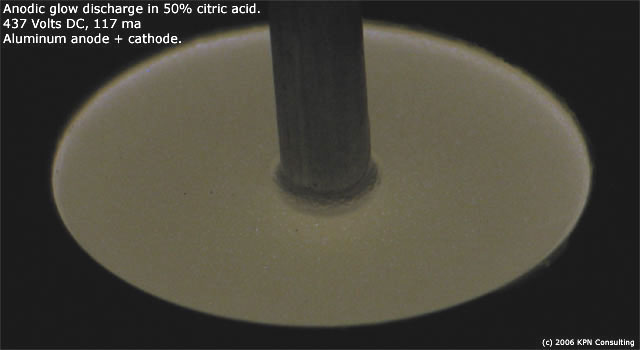
Note
the white speckles concentrated on the rim and scattered
across the oxide layer, these are the precursors to the
arcing mode. Arcing will start at that luminous crescent
on the rim, and eventually overtakes the glow as the current
sink.
Sodium
Pyrophosphate Electrolyte
Electrolyte
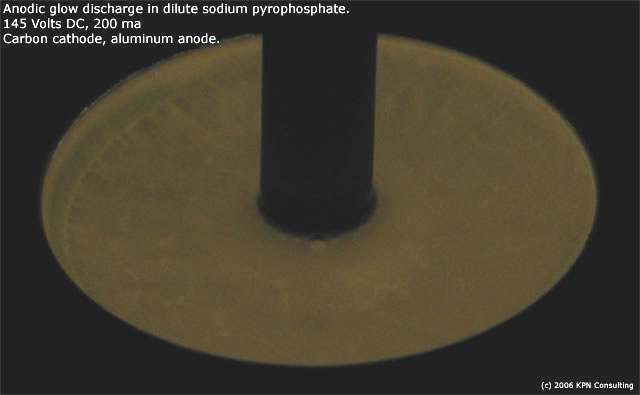
chemistry plays a role in the color of the glow. Here
is a typical high current low voltage discharge in a dilute
sodium pyrophosphate solution. The orange color grows
more intense as anodizing continues.
I
found it hard to control temperature at these current
densities, and some electrolytes require massive currents
to passivate the anode. Better heat sinking is called
for.
VI
Curve of the anodic glow discharge
A
anode was formed by conditioning in 50% citric acid, washed
in distilled water, and the following 'virgin' VI curve
was measured in a fresh 50% citric acid electrolyte.
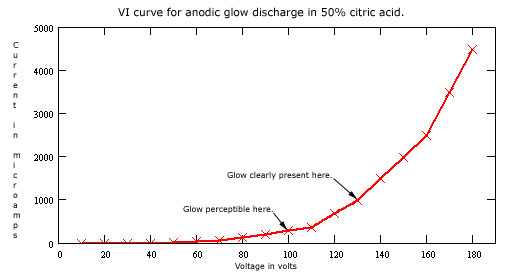
This
curve is typical for anodic discharge experiments and
is somewhat indicative of an electrochemical reaction
described by the Tafel equation, where some fixed potential
is required to initiate the reaction ( in this case around
75 to 100 volts ) and an overpotential is required to
push more current through the cell and increase the reaction.
With these cells the whole overpotential is at the anode
and is often very substantial. It is also the case that
the Tafel a and b parameters can only characterize a particular
discharge experiment, as conditioning can affect both
parameters.
It
is clear from the graph that the glow is connected to
current density. Some intermediate chemical species must
be forming on the aluminum under anodizing conditions
which causes the glow. In the case of high current density
electrolytes a substantial amount of this intermediate
species (or the resulting oxide) is redissolving in the
electrolyte, hence the difficulty in conditioning and
the persistence of a strong glow. To maintain a glow at
a constant current in the case where the oxide layer is
strong and stays formed requires an ever increasing voltage.
Next
Page
Research
home page | Next Page
| Previous page