|
Previous
page | Next page
Unbalanced
forces in a mercury arc?
The
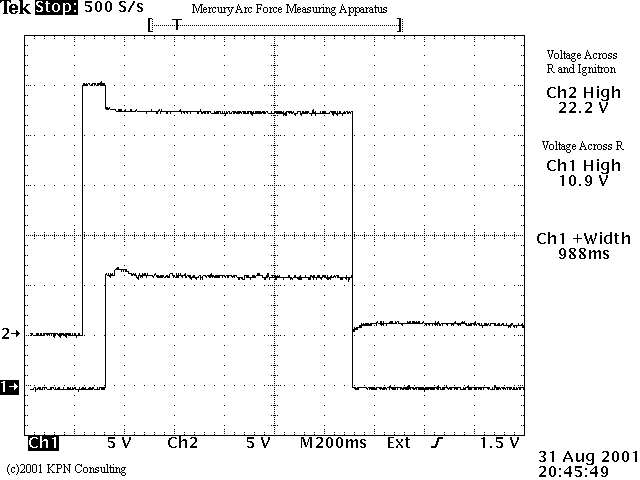
oscillograph below shows a sample run of 1 second. Actual
experimental runs varied but were on the order of 10 seconds.
The graphs were in all other respects identical so just
the calibration run is shown to clarify the pulse sequence
and demonstrate the veracity of the circuit.
On
relay closure total voltage rises to 25 volts. 1/10 of a
second later the ignitron circuit is strobed and the voltage
drops to about 22 volts. The current sense resistor shows
peak pulse current to be 136 amps with a few percent variation
at the leading edge of the pulse.
Fred
Sparber provided the following estimate of the predicted
force.
At
145 amperes and 11.0 volts cathode fall potential an Hg+
ion has a velocity,
v
= [2*11.0*1.6E-19/(1.66E-27*200)]^1/2 = 3.256E-3 meters/second
thus
a momentum,
mv
= 1.66E-27*200*3.256E-3 = 1.08E-21 kg-meters/sec.
For
145 amperes:
F_
ion+ = 1.08E-21*145*6.25E18 = 0.98 newtons
F_electron-
= 0.98/600 = 0.0016 newtons
The
experiment was done first with the clip in place, which
raised the current somewhat due to the lack of an arc drop.
No force was initially noted using 10 sec pulses but some
force developed (~1gram) after several shots. This seemed
to be due to the shorting wire which got VERY hot as you
can imagine. This would not affect the experimental run
as the bulk of the ignitron limits temperature rise greatly.
A
second calibration test was performed using a penny. I dropped
the penny onto the scale portion of the finished apparatus
and noted the scale deflect both in quantity and time until
settled. Removing the penny returned the scale to tare,
showing that the flexible leads were not suffering from
hysteresis. The time to settle was typically between 1 and
2 seconds, due mostly to the digital scale, so 10 sec runs
were done for the final live experiment.
I
then removed the shorting wire and allowed the ignitron
to carry the discharge current. After a few shots with nothing
exploding ( surplus ignitrons being what they are ), I felt
confident enough to stick my head around the corner and
observe the scale. No unbalanced force was noted to within
1 gram, or about .01 newton. I conclude that if the force
is manifesting itself in the arc regime of a mercury tube
that a counter force develops on the anode to cancel it
to within 1%. Newton would be pleased; Fred however was
less than sanguine.
This
experiment should be repeated in the glow and pulsed anomalous
glow regimes, as other researchers have suggested that the
second regime would be more likely to produce an anomalous
force.
The
next page shows some more details of the apparatus.
Previous
page | Next page
|